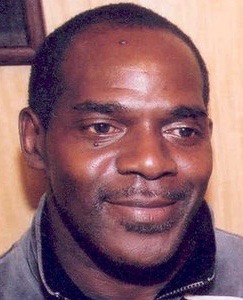
At 12:30 a.m. on January 31, 1984, a 20-year-old student at Saint Louis University entered her car after studying at a friend’s apartment near the school’s campus in St.Louis, Missouri. Before she could lock her doors, a man pushed his way in at knifepoint. The man drove the car to a nearby alley, where he raped and sodomized the woman for two hours before leaving the scene.
The victim, identified as J.D., drove home, called police and was taken to a hospital where a rape kit was taken.
J.D. said her assailant was a clean-shaven Black man, although his face was masked by sweatshirt hood and a scarf. She said he was about 260 pounds, 5 feet 6 inches tall, and 26 to 32 years old. She worked with a police artist to create a composite sketch.
The police showed her a book of about 140 mug shots, and J.D. identified the photograph of 30-year-old Larry Johnson. Each of the mugshots had a listing of the charges they had been convicted of in the past. Johnson’s photo noted he had a prior conviction for sexual assault.
Johnson did not fit J.D.’s description. He had a mustache and weighed 128 pounds. After J.D.’s initial identification, a police officer asked the sketch artist to amend the composite sketch to include a mustache. The revised composite sketch was then shown to J.D.
Johnson was arrested on February 1, 1984, and put into a live lineup. J.D. again identified him as her attacker. Johnson was charged with one count each of forcible rape, forcible sodomy, robbery, and kidnapping.
In August 1984, Johnson went to trial in St. Louis City Circuit Court. J.D. identified him as her attacker, although she said that he looked like had lost some weight.
Joseph Crow, a forensic analyst from the St. Louis police department testified that spermatozoa had been identified on J.D.’s underwear and sweatshirt. Crow said he had not performed serology testing to identify any blood types. The defense presented no evidence.
On August 21, 1984, the jury convicted Johnson of all the charges. He was sentenced to life in prison plus 60 years.
The Missouri Supreme Court affirmed his convictions in December 1986.
In 1995, Johnson contacted the Innocence Project seeking assistance with gaining access to the biological evidence for DNA testing.
Beginning in 1996, the Innocence Project attempted to verify the existence of the evidence. It was told that there was a record saying that the evidence existed, but that the police department would not physically check absent a court order. The Circuit Attorney's Office also refused to cooperate.
In 2000, the Innocence Project filed a federal civil rights lawsuit seeking a court order to obtain access to the biological evidence, arguing that denial of access was a denial of due process.
In February 2001, while the lawsuit was pending, the Supreme Court of Missouri adopted a rule, effective September 1, 2001, that allowed for the filing of motions seeking postconviction DNA testing. The Innocence Project filed a motion for testing on Johnson’s behalf in November 2001.
The following January, the Supreme Court ordered the Circuit Attorney's Office to respond to the motion. Finally, in March 2002, the Circuit Attorney’s Office dropped its opposition to Johnson’s motion.
Testing began at the Missouri state crime laboratory in July 2002. On July 26, 2002, the Innocence Project was told that the Circuit Attorney’s Office had scheduled a press conference for the same day to announce that DNA testing had excluded Johnson as the perpetrator.
On July 30, 2002, Johnson’s convictions were vacated, the case was dismissed, and he was released more than 18 years after his arrest.
Johnson was later awarded $327,650 in state compensation. He also filed a federal civil rights lawsuit, but it was dismissed.
– Maurice Possley
Posting Date: 08-29-2011
Last Update Date: 02-19-2026